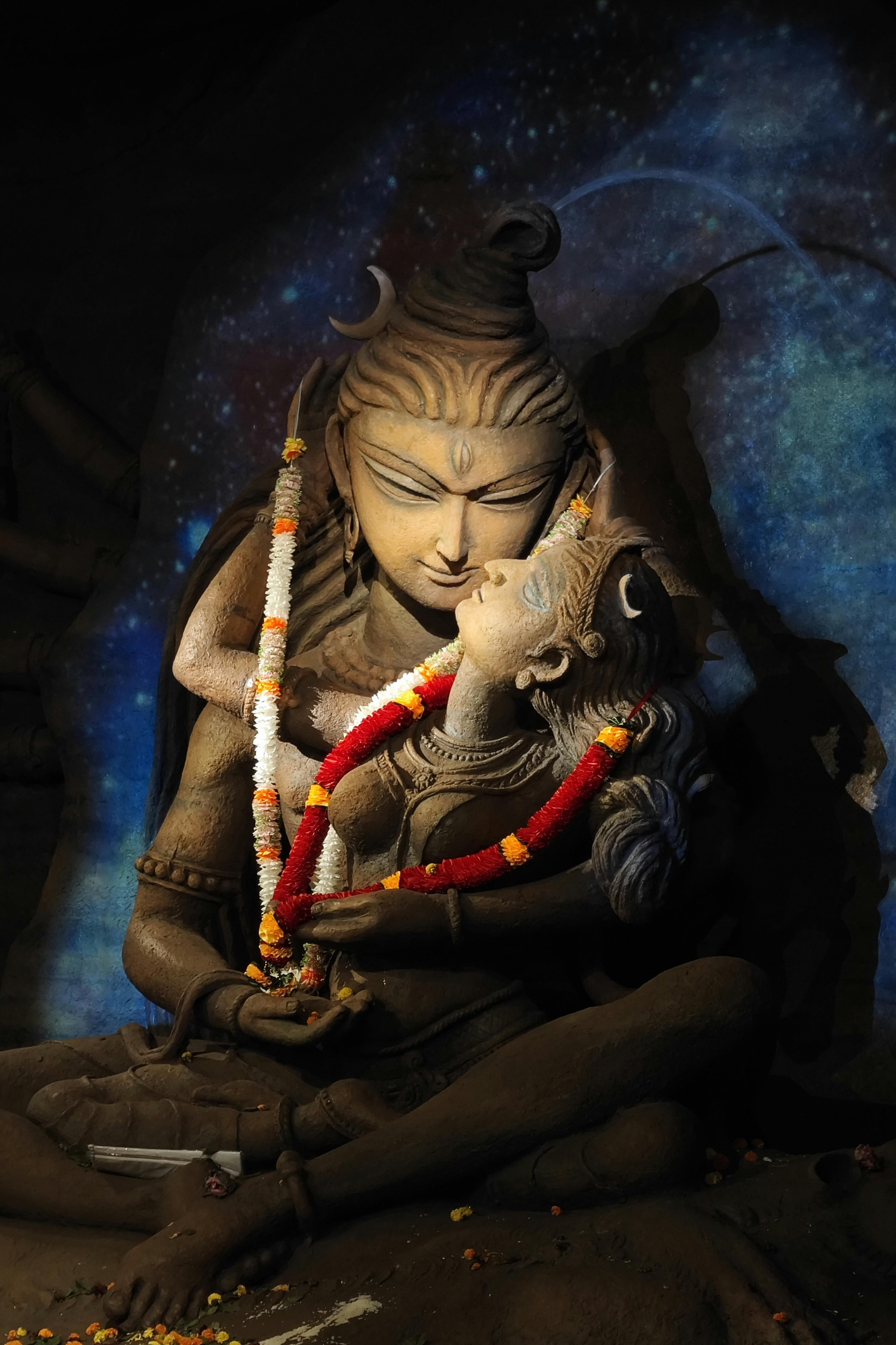
The Origins of Tantra: Tracing the Threads of an Ancient Spiritual Revolution
While the modern West often reduces Tantra to exotic bedroom techniques, its true origins trace back to a radical spiritual revolution in medieval India that dared to declare the divine isn't locked away in distant heavens or rigid rituals, but pulses right here through the body, desire, and the raw mess of everyday life.
You know that moment when something you thought you understood suddenly reveals itself as far richer, more layered, and utterly different from the pop-culture version? That’s how I feel every time I dive into the real story of Tantra. In the West, the word conjures images of candlelit bedrooms, slow breathing exercises, and maybe a few silk scarves—something exotic and vaguely naughty sold as “sacred sexuality.” But step back fifteen hundred years into the dusty plains and misty valleys of medieval India, and you’ll find something far more profound: a radical spiritual movement that dared to say the divine isn’t somewhere else, locked away in temples or abstract heavens. It’s right here, pulsing through your body, your desires, your everyday mess of a life.
Tantra didn’t arrive with a thunderclap or a single prophet. It emerged gradually, like a river gathering tributaries from older streams—Vedic rituals, yogic disciplines, local goddess cults, and the fierce devotion of wandering ascetics. By the time it crystallized into recognizable form around the fifth or sixth century CE, it had already begun transforming Hinduism and, soon after, Buddhism. It challenged the old guard of priestly orthodoxy, empowered women and lower castes in ways that feel startlingly modern, and offered a path to liberation that embraced the world instead of renouncing it. This isn’t the story of one book or one guru. It’s the story of a living tradition woven from centuries of experimentation, secrecy, and bold experimentation by real people—yogis meditating in cremation grounds, poets composing hymns to the Goddess, and scholars arguing late into the night about the nature of reality.
To understand where Tantra came from, we have to start earlier, in the soil of ancient India. The Vedas, those ancient hymns composed between roughly 1500 and 500 BCE, laid the foundation for much of Indian spirituality. They spoke of sacrifice, cosmic order (rita), and the gods who governed it. But even within the Vedic world, there were hints of something wilder. The Rig Veda describes munis—ecstatic wanderers—drunk on soma, their hair wild, their minds expanded, roaming the forests in altered states. Upanishadic sages whispered about the subtle channels (nadis) running through the body, about prana as life force, and about the possibility of realizing the divine within. Sexual symbolism crept in too: the late Vedic texts sometimes equated ritual intercourse with the cosmic sacrifice itself. These weren’t full-blown Tantric practices yet, but they were seeds.
Then came the shift. By the early centuries of the Common Era, India was changing. The Gupta Empire (fourth to sixth centuries) brought political stability, temple-building booms, and a flowering of arts and philosophy. But alongside the grand Vedic sacrifices performed by elite Brahmin priests, something quieter—and more subversive—was stirring among ordinary devotees. Shaivism, the worship of Shiva as the ultimate reality, was gaining ground. Devotees of the fierce, ascetic god who danced in cremation grounds began experimenting with rituals that blurred the line between human and divine. Shaktism, the path of the Goddess (Shakti), celebrated the feminine power that animates the universe. These weren’t separate from Vedic culture; they grew out of it, but they pushed against its rigid hierarchies.
Scholars like Alexis Sanderson and Christopher Wallis (also known as Hareesh) point to around 500 CE as the moment when these currents coalesced into what we now call Tantra. It wasn’t a sudden invention. It was more like a quiet revolution happening in ashrams, mountain caves, and the back alleys of cities across Kashmir in the north, Bengal and Assam in the east, and pockets of the Deccan. The word “Tantra” itself comes from the Sanskrit root tan, meaning “to weave” or “to expand.” In the earliest usages, it referred to a loom or a system—a practical framework for weaving together ritual, philosophy, and direct experience. Later, the texts themselves were called Tantras: instructional manuals revealed by Shiva or the Goddess, often in the form of intimate dialogues between divine lovers. “Tantra means simply a system of ritual or essential instruction,” Sanderson writes in one of his seminal essays. That captures the pragmatic, hands-on spirit of it all.
What made these early Tantric practitioners different? For one thing, they rejected the idea that liberation required total renunciation. Classical yoga and Vedanta often taught that the world is illusion (maya) and the body a prison to escape. Tantra flipped the script. It said the world is the body of the Goddess. Your senses, your breath, your sexuality, even your darkest impulses—these aren’t obstacles; they’re doorways. If you know how to work with them skillfully, they become fuel for awakening. This world-embracing attitude was revolutionary in a culture that prized ascetic withdrawal. It also made Tantra accessible. You didn’t need to be a high-caste male reciting Vedic mantras in Sanskrit. Women, outcastes, and householders could participate, often through initiation into a kula—a spiritual family or lineage led by a guru.
The first Tantric texts began appearing in written form around the sixth century, though they were almost certainly circulating orally much earlier. These were the Agamas and the Tantras—hundreds of them, each tied to a particular lineage. Shaiva Agamas focused on Shiva as the supreme reality; Shakta Tantras exalted the Goddess in her many fierce and benevolent forms—Kali, Durga, Tripura Sundari. Unlike the Vedas, which were considered eternal and authorless (shruti), the Tantras presented themselves as revealed teachings tailored to the current age, the Kali Yuga, when direct paths were needed because the old rituals had grown stale.
One of the most striking features of these scriptures is their form: a conversation between Shiva and Shakti. Picture it—Shiva, the motionless consciousness, and Shakti, the dynamic energy of creation, sitting together on a sacred mountain. She asks the questions; he answers. Or sometimes it’s reversed. This dialogue format wasn’t just literary flair. It embodied the core Tantric insight: reality is a dance of polarities—static and dynamic, male and female, transcendent and immanent—that are ultimately one. The texts cover everything from temple architecture and mantra recitation to subtle-body yoga, the raising of kundalini energy through the chakras, and rituals involving yantras (geometric diagrams that map the cosmos onto a page).
But here’s where the story gets juicy—and where a lot of modern misunderstandings creep in. Early Tantra did include transgressive elements. Some rituals called for offerings that orthodox Brahmins would find horrifying: meat, alcohol, even symbolic (or, in extreme cases, actual) sexual union in the context of initiation. Practitioners sometimes meditated in charnel grounds surrounded by corpses, using the macabre to shatter ordinary perceptions of purity and impurity. Why? Because Tantra taught that the divine isn’t confined to the “clean” or the socially acceptable. True power—Shakti—flows through everything. By ritually engaging with what society rejects, the adept transcends dualities and realizes the non-dual nature of reality. It was spiritual shock therapy, not hedonism.
Christopher Wallis, in his book Tantra Illuminated, emphasizes this point beautifully. He describes non-dual Shaiva Tantra as a tradition that sees the Divine as both transcendent (Shiva as pure awareness) and immanent (Shakti as the flowing energy of the universe). “You cannot think your way to enlightenment,” he writes. “Uniquely empowering, transformative practices are necessary.” Those practices—mantra, mudra, visualization of deities, breathwork, and the cultivation of aesthetic beauty—were designed to awaken the practitioner to the truth that “the Divine is everything the eye can meet.”
By the eighth century, Tantra had moved from the margins into the mainstream of Indian religious life. Kings and queens patronized Tantric temples. Monasteries in eastern India became centers of learning where Shaiva and Buddhist scholars debated and borrowed from one another. This cross-pollination gave rise to Vajrayana Buddhism—Tantric Buddhism—which adapted many of the same techniques: deity visualization, subtle-body practices, and esoteric initiations. The first clear evidence of Buddhist Tantra appears around the seventh century with texts like the Vairocanābhisaṃbodhi Sūtra. By the ninth and tenth centuries, great masters like Abhinavagupta in Kashmir were synthesizing entire systems. His massive Tantraloka (Light on Tantra) remains one of the most sophisticated philosophical works ever written in any tradition.
The relationship between Hindu and Buddhist Tantra is fascinating and sometimes contentious. Scholars like Ronald Davidson and Sanderson have shown how Vajrayana borrowed heavily from Shaiva sources—mantras, rituals, even some deities—but reframed them within Buddhist philosophy of emptiness (shunyata) and compassion. Buddhist Tantra emphasized swift enlightenment in one lifetime, using the same energetic practices but directing them toward the bodhisattva ideal. In Tibet, these teachings would later flourish as the Vajrayana schools we know today. Meanwhile, in India, Tantra helped fuel the Bhakti movement, that great wave of devotional love that swept across the subcontinent.
Of course, no spiritual revolution goes unchallenged. Tantra’s openness to the body and its occasional use of taboo substances made it an easy target for critics. Orthodox Brahmins saw it as degenerate. Later Muslim invaders and colonial British writers portrayed it as black magic or sexual excess. By the twelfth and thirteenth centuries, Tantra began to decline in many parts of India as political turmoil and invasions disrupted the great centers of learning. Yet it never died. Fragments survived in Kerala’s temple rituals, in the folk traditions of Bengal and Assam, and in the hatha yoga lineages that eventually gave us modern postural yoga. Kashmir Shaivism preserved the non-dual philosophy in exquisite detail until the twentieth century.
What strikes me most when I read the old texts is how human the whole thing feels. These weren’t abstract philosophers in ivory towers. They were people wrestling with the same questions we wrestle with today: How do I live fully in a world full of suffering? How can my desire be a path to freedom rather than a chain? How do I touch something sacred without leaving my body behind? Tantra’s answer was radical inclusion. It said yes to life—all of it.
Fast-forward to the modern era, and the story takes another twist. When Tantra reached the West in the late nineteenth and early twentieth centuries—through figures like Sir John Woodroffe (Arthur Avalon) and later the controversial teacher Pierre Bernard—it got filtered through Victorian anxieties and Orientalist fantasies. The sexual elements, which in classical Tantra were just one small, highly regulated part of a vast system, got amplified into the whole story. By the 1960s counterculture and the work of teachers like Osho, “Tantra” had become shorthand for enlightened sex workshops. That version has its place—there’s real value in conscious intimacy—but it’s a far cry from the original.
The true origins of Tantra remind us that spirituality doesn’t have to be sanitized or disembodied. It can be fierce, sensual, intellectual, devotional—all at once. It can meet us exactly where we are, in our imperfect, desiring, breathing bodies, and say: this is enough. This is the loom on which the universe is woven. Sit down. Pick up the threads. Weave.
Today, as interest in Tantra surges again—through yoga studios, online courses, and serious scholarly translations—we have a chance to reconnect with its roots. Not to romanticize the past, but to let those ancient voices speak into our present. The practitioners of 500 CE didn’t have smartphones or climate anxiety, but they knew about impermanence, about the ache of separation from the divine, and about the wild joy of discovering it was never far away.
In the end, the origins of Tantra aren’t just historical trivia. They’re an invitation. An invitation to stop running from the messy, beautiful reality of being human and instead to recognize it as the very ground of awakening. Shiva and Shakti are still dancing. The question is whether we’ll join them.
About Me

Trending Post




Stay up-to-date
Related Post

Learn exactly what to look for—and what to avoid—when choosing a tantra massage practitioner in the San Francisco Bay Area so you can feel safe, respected, and deeply nourished in every session.

Discover how working with a Source Tantra Certified Tantra Educator in the San Francisco Bay Area can turn vulnerable intimacy work into a safe, heart‑opening journey that transforms your body, relationships, and sense of self
Discover how stressed‑out Silicon Valley men are finding deep relief, emotional reset, and renewed passion through tantra massage sessions with Karuna Hart in San Jose.

Learn what to look for in a tantra massage therapist in the San Francisco Bay Area so you can feel safe, respected, and deeply supported while exploring conscious touch and sensual awakening.